
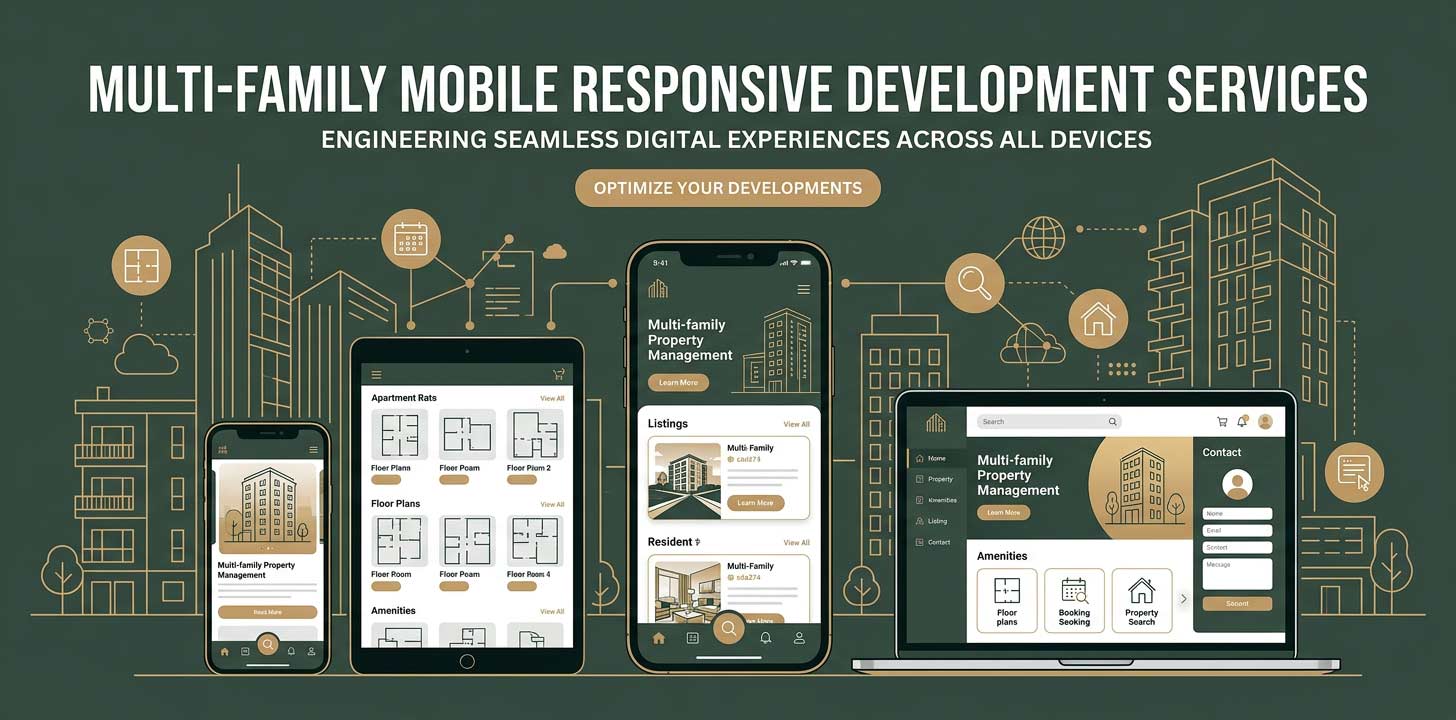
Mobile-Responsive Website Development for Apartment Communities
Pick up your phone and search for apartments right now. That is exactly what your prospective residents are doing—and if your community's website does not deliver a fast, beautiful, effortlessly navigable experience on that screen, they are already gone. More than 60% of all apartment searches now originate on a mobile device, and evening browsing—when most renters do their most serious research—skews even more heavily toward smartphones. A website that was not built mobile-first is not just a design inconvenience; it is actively costing your community leases every single day. Our specialized mobile-responsive development services help apartment communities throughout Los Angeles, California, and nationwide deliver the seamless mobile experience that today's renters demand and Google's algorithm rewards.
With over 10 years developing websites exclusively for multifamily properties, we understand how apartment renters actually use their phones during the search process—what they look for first, where they get frustrated, what makes them tap the call button versus bouncing back to Google to try the next result. Every mobile experience we build is informed by this deep understanding of renter behavior on small screens.
What Does Mobile-Responsive Development Mean for Apartment Websites?
True mobile responsiveness goes far beyond making your desktop website legible on a small screen. A mobile-responsive apartment website uses fluid grid layouts, flexible images, and intelligent breakpoints to deliver a purpose-built experience at every screen size—from a 4-inch smartphone to a 13-inch tablet to a 27-inch desktop monitor. Navigation is reimagined for thumbs rather than mouse pointers. Floor plan galleries are touch-optimized for swiping rather than clicking. Contact forms are simplified to reduce friction on a small keyboard. Page elements are prioritized so the most conversion-critical content appears above the fold on mobile without requiring any scrolling. Phone numbers become tap-to-call links. The result is not a shrunk-down version of your desktop site—it is a fully considered mobile experience designed specifically around how renters behave on their phones during an apartment search.
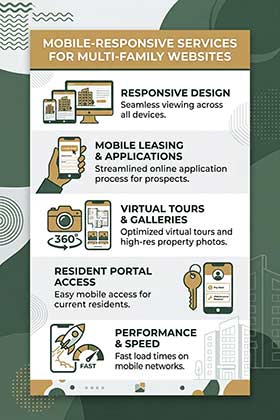
Our Mobile-Responsive Development Services Include:
Why Choose Our Mobile Development Services for Apartments?
1. We Design Around Renter Behavior on Mobile, Not Just Screen Sizes
Most developers approach mobile responsiveness as a purely technical challenge—make the layout reflow correctly at different breakpoints and the job is done. We approach it as a conversion challenge: what is a renter actually trying to accomplish when they pull up an apartment website on their phone at 9pm on a Tuesday? They want to quickly assess whether the community matches what they are looking for, see the most important photos without effort, find out what units are available and at what price, and contact the leasing office if they are interested—all with minimal typing and zero confusion. Every mobile decision we make is filtered through this behavioral lens, resulting in mobile experiences that are genuinely easy to use rather than merely technically responsive.
2. Mobile Performance That Directly Improves Google Rankings
Google switched to mobile-first indexing in 2019—meaning it evaluates the mobile version of your website to determine your rankings in both mobile and desktop search results. Your apartment community's position in local search for terms like "apartments for rent in [your city]" is directly influenced by how fast and how functional your website is on a mobile device. Slow load times, unresponsive layouts, and poor Core Web Vitals scores are active ranking penalties. We build to Google's mobile performance standards from the first line of code, ensuring your mobile investment pays dividends in organic search visibility as well as conversion rates.
3. Speed as a First-Class Priority
Speed on mobile is not the same challenge as speed on desktop. Mobile users are frequently on cellular connections with variable signal quality, using devices with less processing power than a desktop browser, often multitasking and easily distracted. Research shows that 53% of mobile users abandon a website that takes more than three seconds to load—and in apartment marketing, that means a prospect who found your community, was interested enough to click, and then left before seeing a single photo. We optimize every aspect of mobile performance: image compression and next-generation formats, lazy loading, render-blocking resource elimination, server-side caching, and content delivery network configuration. Three seconds is the ceiling. Under two is the goal.
4. Remediation Without a Full Rebuild
Not every apartment community needs a brand-new website to achieve excellent mobile performance. Many existing sites can be significantly improved through targeted mobile remediation—fixing the specific layout, speed, and usability issues that are costing leads without replacing the entire website. We conduct a thorough mobile audit of your current site, identify the highest-impact issues, and provide a clear remediation roadmap with honest guidance on whether targeted fixes will be sufficient or whether a full rebuild is genuinely warranted. We will never recommend more work than your situation requires.
"More than 70% of our website traffic was mobile but our site was designed five years ago for desktop. After the mobile remediation, our mobile bounce rate dropped by 35% and our phone call conversions from the website more than doubled. We had no idea how much we were losing."
- Leasing Manager, 175-unit community in Koreatown, Los Angeles
The Cost of a Poor Mobile Experience for Apartment Communities
You Lose Prospects in the First Three Seconds
A prospective renter who clicks through to your website from a Google search result or an Instagram ad has already demonstrated meaningful interest in your community. That interest evaporates almost instantly if your website loads slowly or renders poorly on their phone. The prospect does not wait, does not scroll to see if it gets better, and does not give you a second chance—they tap the back button and click the next result in the list. Every slow-loading, mobile-broken page view is not just a missed lead. It is a qualified prospect you paid to attract—through SEO investment, ILS fees, or paid advertising—who left without seeing what you had to offer.
Google Penalizes Poor Mobile Performance in Search Rankings
The relationship between mobile performance and search rankings is direct and well-documented. Google's Core Web Vitals—Largest Contentful Paint, First Input Delay, and Cumulative Layout Shift—are confirmed ranking signals that measure exactly the aspects of mobile performance that matter most to users. Apartment communities with poor Core Web Vitals scores rank lower in local search results than competitors with better-performing mobile sites, all else being equal. In a competitive market where the difference between appearing in the top three local results and appearing on page two can mean dozens of leads per month, mobile performance is a competitive advantage you cannot afford to cede.
Mobile Friction Kills Form Completions and Tour Requests
Even prospects who stay on a poorly optimized mobile site frequently fail to convert because the conversion actions are too difficult to complete on a small screen. A contact form with eight fields and tiny text inputs, a floor plan page that requires horizontal scrolling to view pricing, a phone number that is not a tap-to-call link—each of these friction points represents a percentage of your mobile audience who gave up before reaching out. Small usability improvements in mobile conversion paths consistently produce outsized results because the friction being removed was disproportionately affecting the largest segment of your website traffic.
Non-Responsive Sites Undermine Your Brand Credibility
A website that breaks on mobile does not just inconvenience prospective renters—it signals something about your community's standards. Renters make rapid, subconscious judgments about a property based on its digital presentation, and a website that feels outdated or broken on their phone suggests—fairly or unfairly—that attention to detail and upkeep may not be priorities at the physical property either. In the highly competitive apartment market, where prospects are comparing multiple communities simultaneously, this credibility gap can quietly eliminate your community from consideration before your leasing team ever gets a chance to make their case.
Our Mobile-Responsive Development Process
Phase 1: Mobile Audit & Performance Baseline (Week 1)
We begin with a comprehensive mobile audit of your existing website using Google Search Console, Google PageSpeed Insights, and real-device testing across a range of iOS and Android devices. We measure and document your current Core Web Vitals scores, identify all layout and usability issues at each major breakpoint, catalog tap target sizing problems, test form completion on mobile keyboards, and establish a clear performance baseline. You receive a prioritized audit report with specific findings and recommended remediation actions ranked by their expected impact on mobile conversion rates and search rankings.
Phase 2: Strategy & Approach (Week 1-2)
Based on the audit findings, we develop a clear recommendation: targeted mobile remediation of your existing site, a mobile-focused redesign of specific high-traffic pages, or a full mobile-first rebuild if the underlying architecture is too constrained to achieve the performance needed through remediation alone. We present the options transparently with honest assessments of what each approach will and will not achieve, along with realistic timelines and investment levels, so you can make an informed decision based on your community's specific situation and goals.
Phase 3: Development & Optimization (Weeks 2-8)
Development proceeds on a private staging environment with continuous real-device testing at every stage. We work through the responsive layout system, touch interaction design, image optimization pipeline, page speed improvements, and conversion path enhancements in a structured sequence, validating each component against our mobile performance benchmarks before moving to the next. For full rebuilds, the timeline extends to the full project scope. For targeted remediations, most critical improvements can be deployed within two to four weeks.
Phase 4: Testing, Launch & Monitoring (Ongoing)
Before any changes go live, we conduct exhaustive cross-device and cross-browser testing: every major page template on the most common iOS and Android devices, in both portrait and landscape orientation, across Chrome, Safari, Firefox, and Samsung Internet. We verify Core Web Vitals scores meet our performance targets, confirm all forms and integrations work correctly on mobile, and validate that all tap-to-call links are functioning. Post-launch, we monitor Core Web Vitals and conversion metrics to confirm the improvements are delivering the expected results in real-world conditions.
Mobile Features We Specialize In for Apartment Websites
Mobile-Optimized Floor Plan Galleries
The floor plans page is the most visited and most conversion-critical page on most apartment websites, and it is also one of the most commonly broken mobile experiences. Dense comparison tables, tiny interactive floor plan graphics, and multi-column layouts that collapse illegibly on small screens all create the kind of mobile friction that sends prospects to a competitor. We design and develop floor plan experiences built specifically for touch-screen browsing—swipeable galleries, tap-to-expand details, clean single-column layouts at mobile breakpoints, and prominent click-to-inquire actions that make taking the next step effortless on any screen size.
Tap-to-Call and Mobile Lead Capture
Every phone number on a mobile-optimized apartment website should be a tap-to-call link—no exceptions. We implement click-to-call functionality throughout your site and complement it with strategically placed mobile-optimized contact forms that request only the information genuinely necessary for a leasing inquiry. Shorter forms with large tap targets and mobile-friendly input types—autocomplete-enabled name fields, numeric keypads for phone numbers, email-type inputs for address fields—consistently produce higher completion rates than forms designed for desktop keyboards and ported unchanged to mobile.
Mobile-First Photo Galleries and Virtual Tours
Photography is the primary decision driver for apartment renters, and photo galleries must work flawlessly on mobile to do their job. We implement touch-gesture photo galleries with swipe navigation, pinch-to-zoom capability, and optimized image loading that delivers high-quality visuals without the load-time penalty that kills mobile engagement. Virtual tour embeds are configured to load efficiently on mobile connections and render correctly within the mobile layout without breaking the page structure around them.
Progressive Web App Features
For communities looking to deliver a best-in-class mobile experience, we implement Progressive Web App (PWA) features that give your apartment website app-like capabilities in a mobile browser—offline availability for previously visited pages, home screen installation prompts, push notification support, and instantaneous page transitions that feel native rather than web-based. These features are particularly valuable for communities targeting young professional renters who spend the majority of their digital lives in mobile apps and have high expectations for the smoothness of mobile experiences.
Frequently Asked Questions About Mobile-Responsive Apartment Websites
My website looks fine on my phone—does it still need mobile optimization work?
Possibly—there is a meaningful difference between a site that looks acceptable on the specific phone you use and one that is genuinely optimized for the full range of devices your prospects use. We recommend checking your Google Search Console for mobile usability errors, running your site through Google's PageSpeed Insights tool on mobile, and reviewing your analytics to compare mobile bounce rates against desktop. In our experience, the majority of apartment websites that owners consider "mobile-friendly" have significant performance gaps on mobile that are actively costing them leads, even if the layout appears superficially correct.
Can you fix our mobile issues without rebuilding the entire website?
In many cases, yes. Targeted mobile remediation—addressing specific layout problems, speed issues, and conversion friction points without rebuilding the entire site—is a cost-effective option for communities whose overall website is sound but whose mobile experience has specific deficiencies. The right approach depends on what the mobile audit reveals. If the underlying code architecture is fundamentally incompatible with true mobile responsiveness, a rebuild may be the more economical long-term solution. We give you an honest assessment of both options before recommending either.
How does mobile responsiveness affect our Google Ads performance?
Significantly. Google uses mobile landing page experience as a component of Quality Score, the metric that determines both your ad position and how much you pay per click. A poor mobile landing page experience—slow load times, difficult navigation, high bounce rate—lowers your Quality Score, which means you pay more per click and appear lower in paid search results than competitors with better mobile landing pages. Improving mobile performance simultaneously reduces your cost per click and improves your ad position, compounding the value of the investment across both organic and paid channels.
Should we build a separate mobile website or a single responsive site?
A single responsive website is unequivocally the right approach for apartment communities. Separate mobile websites (served from an m-dot subdomain) create duplicate content issues that harm SEO, require maintaining two separate codebases, and frequently fall out of sync with each other—leading to situations where your desktop and mobile sites show different information. Google explicitly recommends responsive design as the best practice for mobile optimization, and it is the approach we implement for every apartment community we work with.
How much does mobile-responsive development cost for an apartment website?
Targeted mobile remediation of an existing apartment website typically ranges from $1,500–$4,500 depending on the size of the site and the depth of issues identified in the audit. A full mobile-first website build is included in our custom website design projects, which range from $6,000–$18,000. Ongoing mobile performance monitoring and optimization is available as part of our website maintenance plans. Contact us for a free mobile audit and a customized proposal based on your community's specific situation.
Ready to Stop Losing Mobile Prospects?
Every day your apartment website delivers a substandard mobile experience is another day you are losing qualified prospects to competitors whose sites work better on the device your renters are actually using. Our specialized mobile-responsive development services help apartment communities throughout Los Angeles, California, and nationwide deliver the fast, beautiful, conversion-optimized mobile experiences that fill vacancies faster and keep your community performing at the top of local search results.
Request your free mobile performance audit today and we will test your website across real mobile devices, measure your Core Web Vitals scores, identify every mobile issue that is costing you leads, and show you exactly what it will take to fix them—with no obligation.
Related Website & Marketing Services
Combine mobile-responsive development with our other specialized apartment website and marketing services for the complete digital foundation your community needs: