
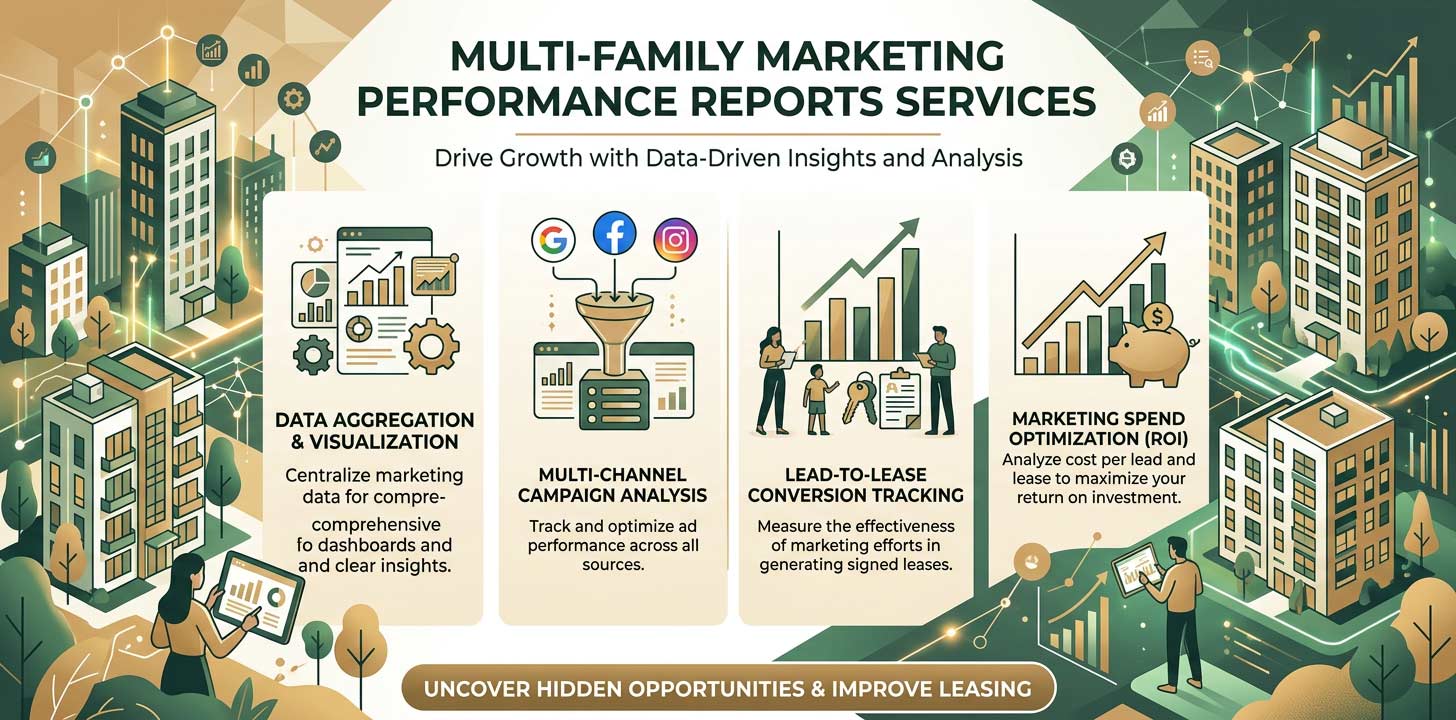
Professional Marketing Performance Reports for Apartment Communities
The average apartment community with a full marketing program receives performance reports from five or six different vendors every month—Google Analytics, their ILS platforms, their PPC agency, their social media manager, their reputation management service, their Google Business Profile dashboard. Each report uses different metrics, different attribution windows, different definitions of what counts as a lead, and different benchmarks for what constitutes good performance. The result is not clarity—it is a stack of optimistic vendor reports that collectively claim to be generating far more leads than your leasing team actually received, with no consistent framework for comparing one channel to another or making confident decisions about where to increase or reduce investment. A consolidated third-party marketing performance report is the single most powerful tool for eliminating wasted marketing spend in a multifamily leasing program—and most apartment communities do not have one. Our specialized multifamily reporting services help apartment communities throughout Los Angeles, California, and nationwide consolidate every marketing channel into a single, clear, trustworthy performance report that drives smarter budget decisions and measurably better leasing outcomes.
With over 10 years producing marketing performance reports exclusively for apartment communities and property management companies, we know which metrics actually predict leasing success, which vendor-reported numbers are inflated by self-serving attribution, and how to present complex multi-channel performance data in a format that leasing teams, marketing directors, and asset managers can all read and act on without a data science background.
What is a Multifamily Marketing Performance Report?
A multifamily marketing performance report is a consolidated monthly document that pulls data from every marketing channel your apartment community operates—website analytics, paid search, SEO rankings, social media, ILS platforms, reputation management, direct mail tracking, and any other active channels—and presents it in a single, coherent framework using consistent metrics and a unified attribution model. Unlike vendor reports that each present their channel in isolation and inevitably in the most favorable possible light, a consolidated performance report gives you the complete, honest picture of how your entire marketing program is performing as a system—which channels are working, which are not, where the budget should move, and what specific actions to take in the following month to improve results.
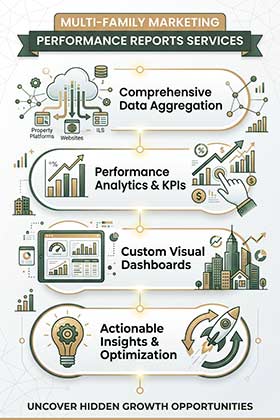
Our Marketing Performance Reporting Services Include:
Why Choose Our Apartment Marketing Reporting Services?
1. One Report Instead of Six Vendor Reports That Contradict Each Other
The fundamental problem with relying on individual vendor reports to understand your marketing performance is that each vendor has a structural incentive to present their channel's performance in the most favorable possible light—using attribution models that maximize their claimed lead count, measuring metrics that their channel excels at regardless of whether those metrics correlate with leasing results, and benchmarking performance against favorable comparisons rather than your actual business goals. When you receive six such reports and attempt to construct a coherent picture of your overall marketing program, you are working with six different perspectives on the same reality, none of them objective. Our consolidated reports pull raw data directly from the underlying platforms—GA4, Google Search Console, Google Ads, social platforms, reputation dashboards—and apply a single consistent attribution framework across all of it, producing the objective picture that vendor reports structurally cannot.
2. Metrics Chosen for Leasing Relevance, Not Vanity
The multifamily industry has a long-standing problem with vanity metrics—numbers that look impressive in a vendor report but have no meaningful connection to whether your community is leasing units. Impression counts that do not produce clicks. Click counts that do not produce form submissions. Form submissions from unqualified prospects that do not produce tours. Social media follower counts that do not translate into inquiries. We build our reporting around the metrics that actually predict and measure leasing success: qualified lead volume by source, cost per qualified lead, website conversion rate by traffic source, tour-to-application rate, and ultimately the cost-per-lease attribution that tells you what your marketing program is genuinely costing per signed contract. Vanity metrics appear in our reports only when they provide useful context for a leasing-relevant metric—never as the headline.
3. Context That Makes the Numbers Meaningful
A raw performance number without context is almost meaningless for decision-making. An organic traffic count of 1,840 sessions tells you nothing useful unless you know whether that is up or down from last month, whether it is above or below your seasonal baseline for that time of year, whether the conversion rate of that traffic improved or declined, and whether a change in any of those metrics is attributable to a specific action your team took or an external factor like a Google algorithm update. Every number in our performance reports is presented with the context required to interpret it correctly—period-over-period comparisons, seasonal benchmarks, explanations of significant changes, and clear flagging of whether a trend requires action or simply monitoring.
4. Reports Your Entire Team Can Read and Act On
The most technically complete performance report is worthless if the people who receive it cannot understand what it means or what to do about it. We design our reporting for the actual readers—leasing managers who need to understand which lead sources require follow-up focus, marketing directors who need to make budget allocation arguments to ownership, asset managers who need a high-level occupancy-correlated performance summary for investor reporting, and on-site teams who need to know which specific actions to prioritize in the next 30 days. Each report section is written in plain language with clear interpretive commentary rather than raw data tables requiring analytics expertise to decipher. The goal is not to demonstrate analytical sophistication—it is to drive better decisions.
"For the first time I could sit down with ownership and show them exactly what we were spending on marketing and what we were getting back from each channel. When we saw that our SEO investment was producing leads at $22 each while one of our ILS enhanced listings was producing them at $480 each, the budget conversation was easy. We reallocated $1,800 per month and our total lead volume actually went up."
- Marketing Director, 4-property portfolio in the Greater Los Angeles area
The Benefits of Consolidated Marketing Performance Reporting
Eliminate Wasted Marketing Budget Immediately
The most immediate financial benefit of a consolidated marketing performance report is the budget waste it reveals and enables you to eliminate. In our experience producing these reports for apartment communities that previously relied on individual vendor reporting, almost every community discovers at least one significant marketing investment—an ILS enhanced listing, a paid social campaign, a display advertising program—that is consuming a meaningful share of the monthly marketing budget while contributing a disproportionately small share of qualified leads. The consolidated cost-per-lead comparison makes this waste undeniable and gives you the evidence to reallocate that budget to the channels actually producing results. For most communities, the budget savings identified in the first consolidated report more than cover the cost of the reporting service for the entire year.
Make Ownership Conversations Straightforward
Property owners and asset managers evaluate marketing performance through a single lens: what is the return on this investment relative to the cost of vacancy? A consolidated marketing performance report that presents cost-per-lead and estimated cost-per-lease by channel—tied directly to occupancy metrics—speaks this language precisely. Instead of defending a marketing budget with a stack of vendor reports that collectively claim to be generating more leads than actually exist, you walk into an ownership review with a single document that shows exactly what each marketing dollar produced, why certain investments were increased or decreased, and what the plan is for the following period. This clarity builds the credibility that gives marketing teams the confidence and autonomy to make the right investment decisions without constant justification.
Identify Performance Problems Before They Affect Occupancy
Marketing performance issues that go undetected for 60 to 90 days can produce occupancy gaps that take months to recover from. A consistent monthly reporting cadence creates the early warning system that catches problems while they are still correctable: a decline in organic search traffic that signals an SEO issue before rankings drop significantly, a sudden increase in cost-per-click that signals competitive pressure in your paid search market before budget is exhausted against poor results, a drop in website conversion rate that signals a technical problem before lead volume falls dramatically. Monthly reporting does not just measure what happened—it enables the rapid response that prevents what happened from becoming a leasing crisis.
Build a Marketing Intelligence Asset Over Time
Twelve months of consistent, well-structured performance reporting produces something more valuable than twelve individual monthly snapshots: a longitudinal record of your marketing program's performance that reveals seasonal patterns, tracks the impact of every strategic change you made, establishes benchmarks for what normal looks like in your market and at your property, and provides the historical context that makes every future performance reading more interpretable. Communities that have been receiving consistent monthly performance reports for two or three years make fundamentally better marketing decisions than those starting from scratch—because their history tells them what to expect in every season, what changes have worked, and what their genuine baseline is rather than a number they need to contextualize fresh every month.
Our Marketing Performance Reporting Process
Phase 1: Data Source Audit & Integration Setup (Week 1-2)
We begin by inventorying every active marketing channel and data source in your program—GA4, Google Search Console, Google Ads, Meta Ads Manager, ILS platforms, reputation management dashboards, social media accounts, email marketing platforms, and any other channels generating trackable data. We establish read-only access to each platform, verify that the underlying tracking is configured correctly to produce reliable data, identify and document any tracking gaps that need to be addressed before reporting can accurately represent those channels, and set up the data consolidation infrastructure that will feed each subsequent monthly report. Where GA4 or conversion tracking gaps are identified, we address these as a prerequisite to reporting.
Phase 2: KPI Framework & Report Design (Week 2-3)
With data access established, we work with your team to define the specific KPIs that matter most for your community's leasing program—aligning on what counts as a qualified lead, what channels are active and should be included, what benchmark periods to use for month-over-month and year-over-year comparisons, and what decisions the monthly report needs to support for your specific team structure and reporting audience. We then design the report template: the layout, section sequence, visualization approach, and written commentary framework that will be used for every subsequent monthly report, ensuring consistency that makes trend identification easier over time.
Phase 3: First Report Production & Review (Week 3-4)
We produce the first monthly performance report, pulling data from all integrated sources, applying the unified attribution framework, calculating all KPIs, writing interpretive commentary for each section, and developing the specific action recommendations for the following month. We present the first report in a live review session with your marketing team—walking through each section, explaining the analytical framework, answering questions about the data, and refining the report structure based on feedback about what is most useful and what should be adjusted. This calibration session ensures subsequent reports are as useful as possible for your specific team's decision-making needs.
Phase 4: Ongoing Monthly Reporting (Monthly)
Each subsequent month, we pull fresh data from all integrated sources, update all performance metrics, write new interpretive commentary that puts current performance in the context of recent trends and external factors, develop updated recommendations based on what the new data reveals, and deliver the completed report by an agreed date each month—typically within the first week of the following month. We are available for a brief monthly review call to discuss the report findings and recommendations with your team, and we flag any urgent performance issues that arise between reporting cycles so you are never waiting until the next report to learn about a significant problem.
What Our Performance Reports Cover
Executive Summary
Every report opens with a one-page executive summary designed for asset managers and ownership who need a high-level performance picture without the detail required by marketing teams. The executive summary presents total lead volume, occupancy trend, marketing spend, estimated cost-per-lease, the most significant performance development of the month—positive or negative—and the single most important action recommended for the following period. It is designed to be read in under three minutes and to answer the question ownership always asks: is our marketing working and are we spending the right amount?
Channel-by-Channel Performance Detail
The core of every report is a channel-by-channel performance section that presents the key metrics for each active marketing channel in your program—traffic contribution, lead volume, cost, cost-per-lead, and conversion rate—alongside period-over-period comparisons and a brief written interpretation of what the numbers mean and whether performance requires any action. Channels are ranked by cost-per-lead to make the comparative efficiency picture immediately visible, and any channel showing significant performance changes—positive or negative—receives additional analytical commentary explaining the likely cause and recommended response.
Website Performance Analysis
A dedicated website performance section pulls from GA4 to present the metrics most relevant to leasing conversion: total sessions and trend, sessions by channel, conversion rate by landing page, top-performing and underperforming pages by engagement and conversion, mobile versus desktop behavior comparison, and the specific pages or conversion paths that changed significantly from the prior period. This section is where we surface the website-level insights that identify conversion opportunities and problems—the floor plan page with declining engagement, the mobile homepage with a conversion rate half that of desktop, the organic search landing page generating significant traffic but minimal conversions.
Reputation & Local Visibility Summary
Reputation and local search performance directly influence leasing outcomes but are frequently omitted from marketing reports or buried in a vendor's platform data. Our reporting includes a dedicated section covering Google review count and rating trend, response rate and recency, ApartmentRatings score movement, Google Business Profile impressions and action metrics—calls, direction requests, website clicks—and any significant review or reputation events from the reporting period that warrant management attention. This section gives leasing and management teams the complete picture of how their community is perceived and found in local search, not just how it is performing in tracked digital marketing channels.
Frequently Asked Questions About Apartment Marketing Reports
We already get reports from all our individual vendors—why do we need this?
Because individual vendor reports are not designed to give you an objective picture of your overall marketing performance—they are designed to demonstrate the value of that specific vendor's service. Each vendor uses the attribution model most favorable to their channel, counts leads using the definition that maximizes their reported volume, and presents benchmarks that make their performance look strong. When you consolidate all of these reports into a single framework with consistent attribution and definitions, the picture that emerges is almost always quite different from what the individual reports suggested—and the budget reallocation opportunities it reveals are typically significant. Independent, consolidated reporting is the only way to know what your marketing program is genuinely producing.
Can you build performance reports for a portfolio of multiple properties?
Yes—portfolio reporting is a core part of our work. We produce both individual community reports and a portfolio-level summary report that presents key performance metrics across all properties in a single view—allowing regional managers and asset managers to identify which communities are performing above or below portfolio benchmarks, allocate additional resources to underperforming properties, and recognize best practices at top-performing communities that can be replicated across the portfolio. Portfolio reporting programs are available at reduced per-property rates compared to individual community engagements.
How do you get access to our marketing platform data?
We request read-only access to each platform in your marketing stack—a permission level that allows us to pull the data needed for reporting without the ability to make any changes to your accounts or campaigns. For GA4 and Google Ads, this is a standard viewer permission granted through your Google account. For ILS platforms, social media accounts, and reputation dashboards, we work within each platform's standard permission framework. All access is documented, and we recommend reviewing and revoking read-only access for any vendor relationship that ends to maintain good account hygiene across your marketing technology stack.
What if some of our marketing channels do not have trackable data?
Most digital marketing channels produce trackable data that can be pulled into a consolidated report. For channels with limited trackability—traditional print advertising, some out-of-home placements, or ILS platforms that do not provide granular referral data—we work with your leasing team to incorporate the intake-level attribution data they capture: how prospects say they heard about the community during inquiry and tour. This combination of platform-level digital tracking and leasing-team attribution data produces the most complete picture available of each channel's contribution, even where perfect digital attribution is not possible. We are always honest about the confidence level of data from less trackable channels and present it accordingly.
How much do apartment marketing performance reports cost?
Monthly marketing performance reporting for a single apartment community typically ranges from $400 to $900 per month depending on the number of active marketing channels, the complexity of the data integration required, and the depth of analytical commentary and recommendations included. Initial setup—data source integration, KPI framework definition, and report template design—is typically a one-time fee of $600 to $1,200. Portfolio programs covering multiple communities are available at reduced per-property rates. For communities that also engage us for marketing execution services, performance reporting is included at a reduced rate as part of the integrated program. Contact us for a customized proposal based on your community's specific marketing stack and reporting needs.
Ready to Finally Know What Your Marketing Is Actually Producing?
Investing in marketing without consolidated performance reporting is like running a business without financial statements—you have a general sense of whether things are going well, but you do not have the specific, reliable information needed to make confident decisions about where to invest, where to cut, and what is actually driving results. Our professional multifamily marketing performance reporting services give apartment communities throughout Los Angeles, California, and nationwide the clear, trustworthy, consolidated reporting that transforms marketing from a collection of vendor relationships into a managed, optimizable program with measurable returns.
Contact us today to discuss your reporting needs and we will assess your current marketing stack, outline the consolidated reporting structure that would give your team the clearest picture of performance, and provide a customized proposal—with no obligation.
Related Analytics & Marketing Services
Build your complete analytics and reporting infrastructure with our other specialized apartment analytics services: